What the interface controls
- Section and task timers continue while you work.
- Listening recordings play once and cannot be paused.
- Reading permits navigation within the current part.
- Writing and Speaking tasks move forward in order.

Listening, Reading, Writing, and Speaking in the order and computer-delivered style the current test uses, built around functional English for everyday, workplace, and community contexts. Canada and Australia accept CELPIP-General for immigration and visa applications, including Canadian permanent residence.
Screenshot slot
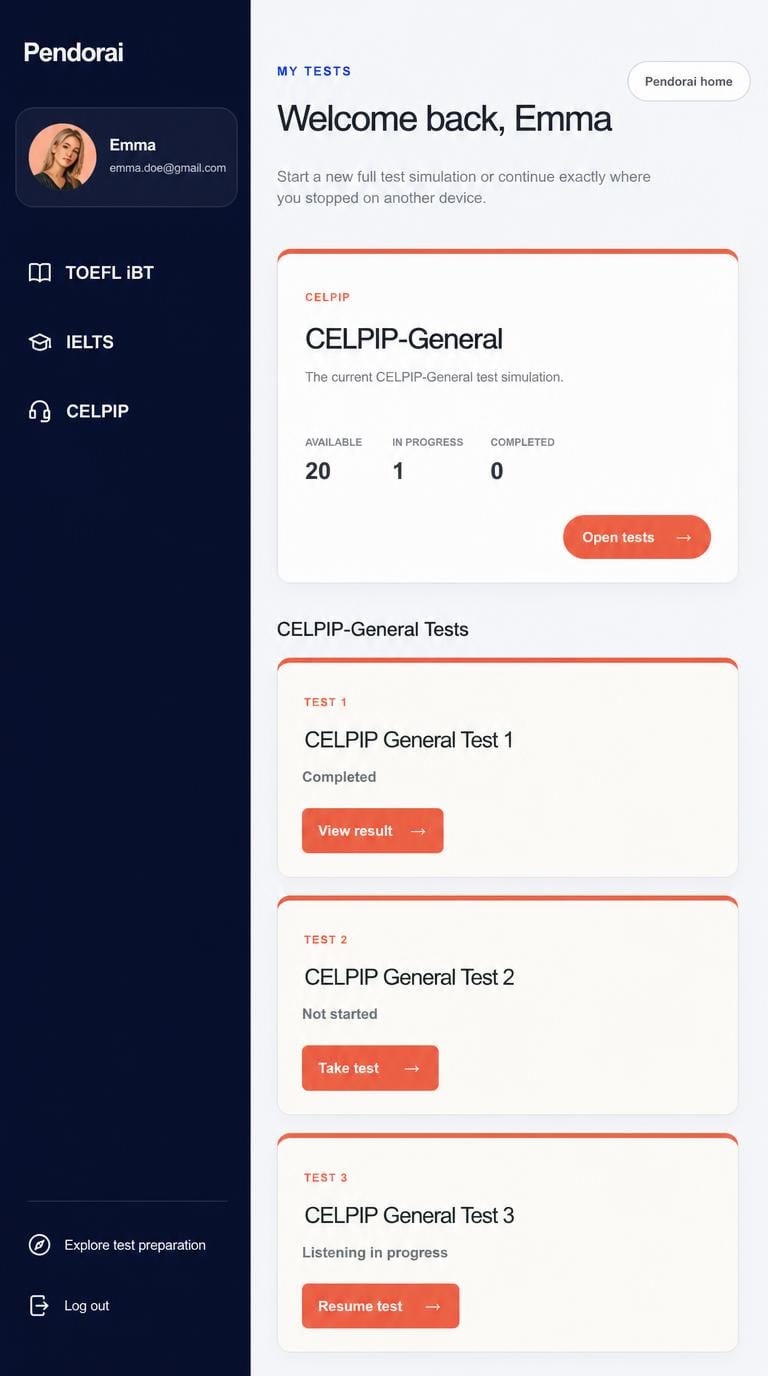
The My Tests dashboard on CELPIP-General — the available, in-progress and completed counts above the test cards.
public/images/tests/celpip-general/exam-runner.jpgOne continuous sitting.
6 parts, 38 scored questions.
4 parts, 38 scored questions.
2 written and 8 spoken.
 Test flow
The test is completed in one sitting. There is no separate Speaking appointment, and a completed section does not reopen.
Listening
46–55 min · 6 parts
Listen once and answer 38 scored questions across practical conversations, information, news, discussion, and viewpoints.
Reading
43–56 min · 4 parts
Move through correspondence, a diagram-based task, an information text, and contrasting viewpoints.
Writing
53 min · 2 tasks
Write an email in 27 minutes, then respond to a survey question in 26 minutes.
Speaking
15 min · 8 tasks
Prepare and record one response for each on-screen situation, including visual and comparison tasks.
Computer deliveredCELPIP is completed on a computer at a test centre. The prompts focus on communication in workplace, community, and daily-life settings, and Speaking responses are recorded through a headset.
ListeningEvery recording plays once and cannot be paused. The section begins with practical problem solving and develops through everyday conversation, information, news, group discussion, and contrasting viewpoints. You hear the audio, but read every answer choice on screen.
8 + 5 questions
Solve a problem, then follow an everyday exchange.
6 + 5 questions
Extract detail, purpose, organization, and implied meaning.
8 + 6 questions
Track several speakers and distinguish positions.
The official test may include unscored items for test development that look exactly like scored ones. Pendorai forms contain scored questions only, so every answer counts toward your estimate.
ReadingYou read correspondence, combine a message with visual information, locate facts in an informational text, and distinguish competing viewpoints.
11 questions · 11 minutes
Understand an email or message exchange and complete a related response.
8 questions · 9 minutes
Use written and visual information together.
9 questions · 10 minutes
Locate and connect information across a longer text.
10 questions · 13 minutes
Separate the writer's position from another contributor's view.
Each part has its own timer, so time left over in one part does not carry into the next.
WritingBoth responses must achieve a practical purpose for a clear audience. The interface keeps the prompt visible and shows a live word count.
27 minutes · 150–200 words
Write to a person or organization about a realistic situation.
26 minutes · 150–200 words
Choose one of two options and persuade the reader.
Responses more than about 10% outside the 150–200 word range can be penalized.
SpeakingThe computer presents each situation, gives you a short preparation period, and records one response through your headset. There is no examiner and no separate face-to-face interview.
30s to prepare · 90s, then 60s to speak
Give practical advice, then tell a clear personal story.
One shared picture · 30s + 60s each
Describe what is visible, then infer what may happen next.
60s to prepare · 60s to speak
Compare options, persuade someone, and resolve a difficult situation.
30s to prepare · 90s, then 60s to speak
Support a position, then explain something unexpected precisely.
Question typesThe simulation covers every scored part listed in the current CELPIP-General format.
ScoringCELPIP reports performance by skill. Pendorai produces a practice estimate from deterministic objective answers and criterion-based evaluation of your own written and recorded responses.
Raw mark out of 38, converted with CELPIP's published approximate ranges.
Raw mark out of 38, converted with CELPIP's published approximate ranges.
Content, organization, vocabulary, readability, and task fulfilment.
Content, vocabulary, listenability, and task fulfilment.
Official CELPIP levels run from M (minimal proficiency or insufficient information) through 3–12, aligned with the Canadian Language Benchmark (CLB) levels. Pendorai results are practice estimates, not official CELPIP scores.
In PendoraiSit a full paper, or drill one task type until it stops costing you marks. Either way it is marked, explained, and folded back into what you study next.
The full interaction, not a worksheet.
One-play protected audio, forward-only section flow, timed Writing tasks, and real browser microphone recording reproduce the decisions you make on test day.
Functional English stays functional.
Sources and prompts come from plausible Canadian workplace, service, community, and everyday settings rather than recycled academic-test topics.
Feedback goes beyond one number.
Objective answers are reviewed item by item. Writing and Speaking return criterion evidence, focused improvements, transcripts, and high-scoring examples.
The same study plan feeds every exam you sit. Pick the next one.